You can’t set foot in the Substack feed without getting inundated by takes about the literacy crisis, waning attention spans, and why technology is making everything worse. Some days, I feel like a doomer too. But this doesn’t have to be how you experience the internet. I wanted to talk to somebody who has managed to not only retain, but also deepen their engagement with art, culture, and literature via the internet and social media.
is a writer, software designer, and literary critic who writes the Substack . Her newsletter is unabashedly highbrow in subject, but enthusiastic and accessible in tone—somewhere in between “fancy European curator” and “bubbly lit prof.” In this lovely and very generative conversation, we discuss:
[00:00:00] Jumping from Silicon Valley to the art world
[00:11:00] The internet and “research as leisure activity”
[00:26:34] Contrarian optimism about AI and art
[00:48:57] How can we measure progress in culture?
[01:04:47] Celine’s personal tech/media habits
You can subscribe/rate/listen to my podcast on Spotify, Apple, or YouTube.
P.S. I just went on ’s podcast to talk all things Silicon Valley politics, and check in on the tech right a year after the election. It’s one of my favorite podcasts I’ve done—you can listen to the episode here. (They’ve also just been doing great journalism on #girlbosses, education policy, AI, and more.)
Transcript
Jasmine Sun: [00:00:00]: Celine is a writer, a software designer, and a literary critic who writes the Substack . I think we first met via the Substack comments section and then we’re in an SF writing circle together before she moved to London. I’m so excited to have her on today. Welcome, Celine!
Celine Nguyen: [00:01:06] Thank you for this very kind introduction. I’m quite excited because I feel like the range you have for the podcast in terms of technologists, creatives, media people, and academics has been really great.
Jasmine Sun: [00:01:21] The question I want to start with is that you have said that the mission of your Substack personal canon is to “expand the market for literature.” I really like that you frame it this way, and I would love for you to tell me more about what that means.
Celine Nguyen: [00:01:36] So I’m 31 now. For most of my twenties I was very, very much immersed in Silicon Valley startup language. So obsessing over a total addressable market was just a very familiar thing. And something I found fascinating when I did an MA at the Royal College of Art in London, halfway through my twenties, was going from this very CS/tech/Silicon Valley world into the arts and humanities world.
When you’re in the tech world, it just feels like things are always expanding. Things are always getting better and better. There’s more technology penetrating every aspect of society. Whereas in the arts and humanities world, there’s this kind of feeling of decline. Funding is shrinking. A lot of tenure track positions are not being replaced. There are all these scare stories about how fewer people are majoring in the arts and humanities. So I think just that shift from this world that is constantly growing to this world that feels itself to be contracting and under threat was so interesting to me.
I am curious about what it takes to bring that kind of optimism and that feeling of expanding possibility into the humanities. I went to undergrad and studied computer science. I learned to code. And then when I became more interested in literature, history, philosophy, and so on, I just felt like I had this incredibly, intellectually expansive period of my life. So I feel that there are a lot of people who are interested in the humanities, and it’s about figuring out how do you bring more people into the fold.
Jasmine Sun: [00:03:19] What was it that propelled you to go from Silicon Valley to thinking I wanna go to art school in the first place?
Celine Nguyen: [00:03:28] I’ve been referring to that period as my quarter-life crisis. In my case, and this might be true of other people, it became very easy to go through a very specific track, especially in the US. It’s like, I want to be in a certain discipline. I want to be in a certain profession. I’d better choose the exact right undergraduate program for that. I’d better choose the exact right starting job outside of college.
And then you get funneled into that and then you’re kind of like, Okay, wait. I’ve done everything I’m supposed to do. Where’s the self-actualization going to happen? When am I going to feel fully content with my life and fully individuated? And those end up being the questions that people turn to artistic, cultural, philosophical, humanistic pursuits often to try and answer.
Jasmine Sun: [00:04:24] Did you have imposter syndrome at all when you were going to art school?
Celine Nguyen: [00:04:29] I definitely did. I feel like I’ve only shaken off that feeling maybe in the last year. But I still have quite a lot of it stuck to me.
Every discipline has a different set of reference points. So if you are an 18-year-old who’s just enrolled in a CS program, you’ll hear people around you making jokes about different sorting algorithms, and they’ll be like, oh, bubble sort, don’t use that. It’s all these memes that everyone is just expected to know. And if you don’t know them, then you have this edge of fear where you’re like, oh my God, am I supposed to know that? Am I supposed to know the details of how JavaScript typing is really annoying and upsetting to use?
What I experienced was this feeling of, there’s this set of proper nouns that people who are in this other world know. In my master’s program, about a third of them had done art practice disciplines, a lot of art historians, and a lot of historian historians. I didn’t realize that Walter Benjamin was this person that everyone knew. I felt like I had to do a lot of reading to catch up. I felt very intimidated and I think that has shaped a lot of how I write my newsletters, where I want to tell people, this is the background context. If you don’t know it, it’s okay. You want to instruct people if they don’t know, but in a way that’s not condescending, and there may also be an audience that is familiar with this.
Jasmine Sun: [00:05:58] I do think that approach shines through in the way that you write your own work. But one of the things that I admire about you is that you just do have crazy discipline for, I believe that I can master this new field. Can you tell people about how you did get yourself up to speed on all of these theorists? You did go and learn the proper nouns, right?
Celine Nguyen: [00:06:22] I did a lot of reading that was not very strategic. For example, in the arts and humanities, everyone references Marx and everyone has some vague sense of dialectical materialism and things like that. “Dialectical materialism” being that thing that I still Google like once a week.
Jasmine Sun: [00:06:38] So real.
Celine Nguyen: [00:06:45] I know. When will it stick in my brain? But I was like, Marx is an important reference point, so I’m going to start reading Capital, and I was taking really, really exhaustive notes. I was reading Marx’s Capital, and then I was reading the David Harvey guide to it. And then I was just like, okay, this is way too comprehensive. I’m not actually going to read all of Capital and I don’t really need to do that. So there’s a lot of reading ambiently around and not knowing how to get situated in the discipline. There’s a reason that people go through rigorous and kind of formalized education; it is useful for someone to write the syllabus for you instead of you picking up all the names that are referenced, not knowing if you should read all of that person’s work or if there’s just one excerpt that people reference.
One thing that I think was kind of funny is that with Marx, arts and humanities people are always tweeting about “the bolts of linen” and these little in-jokes. Well, those happen very early on in Capital. When people reference the Proust madeleine thing, that’s in Book One. There are all these other books that are after that. So I think there is something demystifying to going straight to the source and realizing that not that everyone else in the world has read all of those things very deeply. Sometimes people are also just making a show of knowledge, which is different than actual knowledge. I don’t mean to say that everyone is a pretender, but for people who are very sincerely trying to learn and feel intimidated, it’s very demystifying to be like, okay, I can access this.
Jasmine Sun: [00:08:24] It’s funny because my high school experience was me googling “dialectical materialism” over and over because I was into critical theory in the way that 15-year-olds are into critical theory, which is not very deeply. And then I go to Stanford and I’m in Silicon Valley all of a sudden. And because I felt so much imposter syndrome and felt like everyone thought I was stupid because I didn’t know what TAM was, I went and read all of the Silicon Valley books. Like Zero to One and The Hard Thing About Hard Things and every single PG essay.
I think it is a good character-building experience to be the kind of person who knows how to get dropped into a new context and learn the codes. And it probably does make one a stronger communicator when we are then trying to communicate about these scenes to the rest of the world. Because in a similar way to how you are trying to make literature more accessible with your writing, I am often doing storytelling or sensemaking about strange Silicon Valley cultures now.
Celine Nguyen: [00:09:31]: Something you do well in your writing—and I think this is the value of just dipping into all these disciplines and worlds that all have their own vocabulary, their own canonical texts—is figuring out how to translate. It’s like this term means this. Not just describing the surface level, “this is the stuff people are saying or doing,” but “here’s the underlying ideology or philosophy or worldview that is transmitted by this.”
In Silicon Valley, people do think of disruption as inherently good. They think of information as inherently abstracted and decontextualized. And some of this comes from the philosophical origins, maybe, of how data structures work, how algorithms work, how you can abstract away from what is the specific data and just think about how to handle it and how to store it. I think there are many ways in which you can critique that and be like, oh, that leads to tech people barging their way into fields where they don’t understand the context. But I think there’s also this positive ideological aspect of tech people believing that they can take these tools and try to solve problems in a lot of different fields. It explains why tech people are always trying to get into health-tech and urbanism and all this stuff.
Jasmine Sun: [00:10:57] That is a good transition to one of my next topics, which is this celebration of amateurism in your work.
One of your most popular pieces is “research as leisure activity.” It went viral on Substack among literary folks, and on Hacker News among tech people—despite being a piece about doing humanistic research. I read that essay as an ode to amateurism, as something that is worthy even in the face of the ivory tower and these deep layers of texts and references that people aren’t necessarily coming in with context on. And I also read it as a celebration, implicitly, of the internet as something that lowers the barriers to doing personal research. Is that right?
Celine Nguyen: [00:12:00]: That’s a beautiful summary and I think what you emphasize at the end—it is, I think, a love letter to the kind of intellectual work or the intellectual curiosity that the internet makes possible.
When I think about my interest in literature, a lot of it was very much facilitated by the internet. I did not grow up in a New Yorker household. My father, like many Eastern Bloc fathers, grew up reading Tolstoy, but then he didn’t necessarily read a lot of that literature later on in his life, especially when he was raising me and my sister. And my mom too was introduced to that stuff. But we weren’t a literary household. And so a lot of the books that I now think of as foundational to how I see the world, to my aesthetic worldview, my ethical worldview, I just found out about because people would post on Reddit or Twitter. I think that is something really special about the internet, that you do not need to be in the right family context, geographic context, social context where these things are automatically accessible to you. You can just discover your interests online.
The sociologist Zeynep Tufekci has this TED Talk about how YouTube encourages political extremism. She’s like, no matter what you’re interested in or no matter what you care about, you’re never extreme enough for YouTube. If you watch a video about vegetarianism, it’ll show you a video about veganism. She was making this point that people talk about YouTube tracking people into certain political views—you’re a little bit conservative and then you turn into an alt-right person. This push into the extremes happens in so many parts of the internet.
Obviously there are many situations in which radicalization can be bad. But it also means that you can develop this intellectual radicalization where you’re kind of like, “Ooh, I wanna know what book I should read,” and then, two years later you’re a brodernist.
Jasmine Sun: [00:13:50] Is this you?
Celine Nguyen: [00:13:51] That’s basically what happened to me. Why am I sitting around spending all my time talking to people about how much I love Mircea Cărtărescu? Why did I hear about this writer? It’s just because I read some Reddit post about him.
Jasmine Sun: [00:14:10] Radicalization for good and for cultural edification.
Celine Nguyen: [00:14:12] Maybe that is what I hope I can do with my newsletter: Do you have some free time? Do you want a book to read on your commute? Have you considered In Search of Lost Time?
Jasmine Sun: [00:14:31] I’m curious, what did you make of the response to that piece?
Celine Nguyen: [00:14:41] It was obviously really gratifying.
Writing on the internet feels like constantly playing some kind of mysterious roulette game. describes it as, in the same way with your investments, you don’t want to time the market, and you just assume that you should invest a lot of money and then over time hopefully receive good investment returns. He’s like, that’s what you should do with your creative work. You should just constantly release things, constantly publish things because you don’t really know what will hit with people. I’ve definitely written things where I was like, this was amazing and it got a little bit of attention, and then that thing I dashed off very, very quickly and it got a lot of attention. It’s probably the most popular, widely circulated thing I’ve done.
It didn’t take that much raw time to write, but a lot of the ideas in it were probably distilled from years of reading random hobbyist internet blogs where it’d be like, there’s this random person who’s just really, really into Japanese interior design. And there’s this random person who’s really into men’s fashion and exactly where a tie should hit. I was thinking about a lot of those random hobbyists online, and how I really feel that so much of the internet and content that does not feel like slop, that actually feels like it’s emanating from this very distinctive subjectivity, this distinctive consciousness—a lot of that comes from people who are just really obsessed about this thing and really want to share it with you. I put all of that into this piece. I tossed it off and then I was like, whoa, this really resonated with people.
Jasmine Sun: [00:16:29] I notice that about my writing as well, where it’s not necessarily the number of hours that I spend writing the piece, but something about the number of hours that the ideas have been marinating for. There have certainly been pieces I’ve dashed off that have done well, but once I really think about it, I’m like, actually, these ideas have been there for quite a while.
This brings me into a critique people make about the internet’s effects on the culture industries: that it promotes audience capture or values capture through seeing all these metrics, the likes and views; and knowing very viscerally and immediately what response you’re getting to your work; and feeling the gap between how proud you feel and how the audience receives it.
As a writer, what role do metrics play for you? And as a critic, how do you look at the effect that these things have on the culture?
Celine Nguyen: [00:17:23] You, as a creative person, are trying to defend yourself against this encroachment of numbers that measure whether your work is worth it or not. The number of likes is not actually how worthy your writing is, but it really feels like that’s the case. And obviously you want to be receptive to feedback, and it’s valuable to know what lands more with people and what lands less, but when all reactions are filtered through the number of views, the number of likes... There are pieces where the number of likes comes from having a very zingy headline.
Jasmine Sun: [00:17:58] The post headline is the tweet is kind of how I think about it. Like there’s certain pieces where you read the headline, it functions as a tweet, and then people hit like immediately.
Celine Nguyen: [00:18:05] Yeah. And I think there’s this funny balance where some writers get way too purist about it and they’re like, I don’t want to have to package my work up for the masses and for the hordes. I think if you really believe in the quality of your work, you owe it to your work to package it in a way where it can reach the most people. There’s obviously a way to do it that is clickbaity and growth hacky and kind of trashy. But then there’s also a way to do it that’s just like, are you backing your own work? Do you believe that it’s meaningful to people? There’s this awkward balance where you want to market your work, but then you also want to retain some purity.
But specific to the writing itself, I have all these weird rituals. I use Arc as a browser and I have it customized so a lot of the numbers don’t show up. When Substack sends me those emails that are like, “It’s been 24 hours since you sent your newsletter. Here’s how well it performed.” I do not read those. I’ve never opened them.
Jasmine Sun: [00:19:08] As you know, I used to be a product manager at Substack and some of these emails and dashboards and analytics are things I built. I was like, I think we should have these and we’re gonna put them in front of writer’s faces. We read the feedback that some people didn’t like it. To be clear, there were other people who really wanted more analytics.
But at the time I’m like, well, don’t you guys want to know your business stats? And now that I write full-time on Substack, I’m that person. I never look at my revenue or subscriber chart ever. I do not want to know. It is not good for my psyche.
Celine Nguyen: [00:19:50] I’d see people post Substack Notes that are like, “I sent out this newsletter and I lost 30 subscribers. But you know what, if you don’t believe in trans rights, good riddance.” And I will say that being able to directly do that cause-and-effect thing, assuming “I did this thing and it had this result, I’m going to now obsess over why that is”—I think it’s really unhealthy. I’ve always tried to avoid doing that. The Substack dashboard where it shows you the number of subscribers, I have an Arc boost that hides that and then I turn it on like once a week. I have journal entries where I’m like, do not look at your numbers until the end of the month.
I obviously want to be read, but I think some of the best work I’ve done has been like, I wrote a 10,000 word newsletter last year about AI and art. That’s kind of an insane thing to do. It probably got fewer likes and views and so on than a lot of my other stuff. But I had this feeling that it would mean so much to me intellectually if I can write something that encompasses all of my complicated, conflicted, excited, nervous, fearful feelings and thoughts about how AI will affect art. And so I think it’s important to protect yourself from stats so that you can preserve a certain independence to do things which are of personal significance.
Jasmine Sun: [00:20:58] And being able to think “I am proud of this piece and I remain proud of it even after it was not received in the way that I wanted it to be received,” at least legibly, I think that is a really important thing.
I also totally agree on the unsubscribes. One debate that I remember having when I worked at Substack was whether or not we should notify people or make more clear how your post drove unsubscribes. And I was like, I don’t think that’s good. Partly because it’s demoralizing and will make people write less, and that’s bad for our metrics. But also as a creative, I think it really traps you. It makes you less experimental. It means that you won’t be able to pivot or try new styles. We weren’t trying to hide it; you can turn on unsubscribe notifications if that is helpful to you. But for the vast majority of writers, it’ll make their creative capacities much more constrained.
I do want to ask though—what metrics do you value? For example, I look at some normal metrics. But the ones that I care about most after I wrote something are, do I get emails or notes from people who I really respect? Even if a post doesn’t do “well” from a likes or views standpoint, if one or two people who I admire send me a note about it, then I’m like, actually, yeah, that was a good one. Also, linkbacks are something that I look at a lot. I really like the feeling of participating in a discourse. I think that’s what makes internet writing really wonderful to me—whether it is critique or celebration, I love the fact that people link to each other’s blogs all the time and you can create micro-discourses this way.
Celine Nguyen: [00:22:42] I think we’re very aligned in this. I also love the feeling of discourse, of a conversation moving back and forth, of there being an actual community.
I almost want to arbitrarily divide the internet into the social media model of communication and then the forum model. And the forum model’s more like, you are one person among many other people. Some people are cooler posters on the forum, or older and more experienced. But in general, there’s this idea that you’re all on an even playing field. All your posts show up at the same size, and you’re also all speaking in this shared space. And then the social media model is more like, there’s the creator and their fans, and they’re projecting to their fans. It’s very one-way. Obviously fans can be in the comments, maybe they can repost. But that hierarchy is endemic to the social media model. And I don’t know, I just really don’t like it. I don’t know if some of it is the social insecurity of, for most of my life, I was a very shy person and was very shy online up until I started my Substack recently. So I’ve never felt I would be the person who would be heard in the social media model. But I think a lot of writing is inherently communicative and the most gratifying part is receiving the thoughtful comments, receiving the email replies in my inbox, seeing someone quote my thing and add on to it and elaborate on it. I feel really touched by those.
Early on, I was sending out newsletters that I would put a lot of time into, and I had a relatively small audience, but then I would have a handful of people come by. It would be people whose newsletters I read and then they would comment on mine and they would be like, oh, that book sounds amazing. Have you looked at this? I learned a lot from people introducing me to new ideas or perspectives. And that feeling of putting something out there in the world, it has touched someone else, they’re communicating back to me, they also have a chance to shape me and shape my thinking—I find that really precious.
Jasmine Sun: [00:24:43] You’re also a very generous participant in this sense. I can tell that you believe in this very horizontal form of participation because you too are a very thoughtful commenter. You’re a generous reader of people’s work. You really engage. A lot of your Substack Notes, for example, are celebrating other writers and things that you’ve been reading.
Celine Nguyen: [00:24:59] One little growth-hacky thing Substack does that I love is notifications that go: Five people subscribed to this other newsletter because of you.
Jasmine Sun: [00:25:07] Oh, because of your share? Yes!
Celine Nguyen: [00:25:08] I’m very incentivized by those. I’m like, I should be posting about other people all the time.
But the whole dark academia community online is about people longing after, sometimes fetishistically, but sometimes in a very sincere way, a certain kind of intellectual community. It’s this feeling that you get to live a life that is about the world of ideas. You get to live a life where you’re constantly discovering new things, where you’re having these meaningful, rich discussions where all the people around you are interested in your intellectual development, and then their intellectual development is also positively impacting yours. I think that fantasy of a certain kind of liberal artsy, #darkacademia environment, that’s what I really crave. I went and did a masters for it, but you can’t stay in grad school forever. And I thought about doing a PhD and then eventually I was like, no, for me it’s not the right decision, but I want to exist in that world. How do I exist in that world for the rest of my life?
This feeling of constantly speaking to other people and taking other people’s ideas—some random commenter, that person could be just as intellectually serious as someone who has a massive following and is more obviously a public intellectual, that’s, to me, part of creating that environment.
Jasmine Sun: [00:26:34] Part of why I became so excited about writing online was a sense that I wasn’t finding the intellectual communities that I hoped for within these institutional contexts.
I also want to ask about your views on AI. We’ve talked about the social media and the forum eras of the internet. Now everyone is very concerned with generative AI and with LLMs and slop, right? In culture communities, the primary perception of AI is that (A) it’s stealing our stuff and (B) the stuff it’s creating is mediocre slop. I’ve read in one of your pieces that you hypothesize that LLMs will increase the urgency and relevance of key humanistic skills. And I also really enjoyed your AI art piece where you talk about how human artists are using AI and appreciating the quirks of the format in its own way. These are pretty hot takes.
I’m curious to talk broadly about your views on AI and also especially how you bridge these identities, as someone who is in both optimistic tech communities as well as a lot of literary communities that are very suspicious.
Celine Nguyen: [00:27:46] I think of myself as a contrarian optimist in many ways, because dispositionally, I’m like, but what if things could be good?
With AI, I think it’s quite worth teasing apart maybe the economic impacts from the artistic impacts. I think actually you had an interview where you made this very astute observation that when people say, “AI can never replace an artist, can never write a poem, can never do something at a certain level,” they’re making this statement about the quality of output that AI will ever be able to develop. You made the observation that often this is really an economic anxiety masked as a creative anxiety. The economic anxiety is the part where I’m really sympathetic to the AI oppositional stance where so many of these models rely on massive data sets in order to produce these results that feel magically intelligent. If you are someone who blogged for years online, or if you’re a random Reddit commenter who wrote all these guides on how to travel to Japan, and then years and years later you are this tiny slice of a data set that gets brought into an LLM, so when someone types in a request that’s like, “I’m planning a 10-day trip to Japan,” some of your work is going into that. We don’t have a sense of how to value those contributions. These AI companies that are valued at billions. What does that mean for everyone else?
The other part of the economic picture is this idea I’m borrowing from the critic , who has a really good Substack notebook and also does really incredible literary criticism. But she has this newsletter post about ecosystems where she talks about how, there’s real capital-A Art, and then there’s a lot of just commercial art or random roles where people are not making cutting-edge contemporary art, but they’re making commercial art that pays the bills that lets them fund the other things.
To me the question of, “Can AI write a Pulitzer-level poem or a Nobel-level poem?” is not the interesting question. It’s more like, where do all the human poets make their money? Are they working as copywriters? Are they able to sustain a living that helps them create their artistic works?
Jasmine Sun: [00:30:08] It certainly feels like things are getting bleaker.
I also wonder if we have ever had an ecosystem where people were doing real art, not the commercial art; not just the copywriting, but the experimental. That has rarely been something that you could sustain as a full-time living ever. Before Substack people would blog every day for free for many years and influenced tons of people, and everyone just had a day job that was something else, right? We and our friend Sheon went to that Day Jobs exhibit down in Palo Alto about artists making art inspired by the day jobs they had. And sometimes it wasn’t even in a creative field, right? It’d be like, “I stock boxes at the grocery store. I am a computer programmer.” Sometimes I wonder if that is a more healthy and sustainable way to approach economic sustainability.
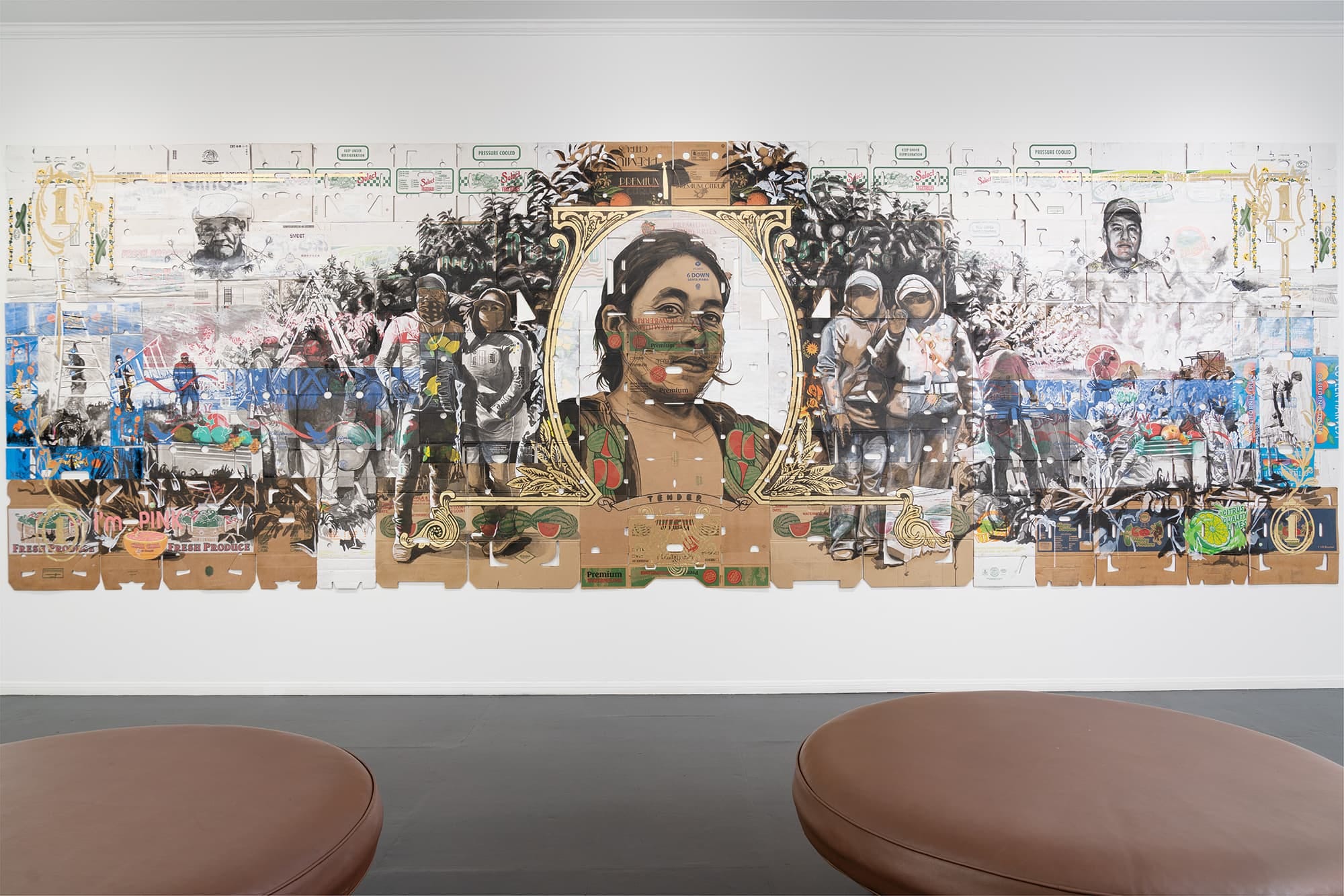
I sometimes feel that if your day job is too close to your creative work, it drains the same pool of creativity and it can in a way be better to have a day job that is totally unrelated. My friend , who is the head of design at Substack and writes a lot, for a very long time was a Tumblr philosophy blogger who would write an essay every single day. He did this working at a Home Depot call center, which is not a super intellectually demanding job. But he’s described it to me as quite symbiotic because it was also such a mindless job that he had all this creativity bottled up. He could think about things while doing his day job and then sit down and bang out essays. It is unfortunate, but maybe we should accept that the super creative stuff is for the vast majority of people going to have to start out not being the main thing and we gotta learn some other job to pay the bills.
Celine Nguyen: [00:31:58] I love this anecdote about Mills, who’s a designer I very much admire.
But yeah, this is something I’m thinking out loud about. When people talk about an ideal world that would produce really great art and really great literature, it can be framed as, we should just have a society where more people can be full-time experimental artists and novelists and stuff like that. And the thing I always get stuck on is, how do you choose who those people get to be? Who’s deciding who’s the genre-defining groundbreaking artist? In the past, you would have tenure track positions or fellowships where people could be shielded from the market and they could do their work. And that isn’t necessarily the most democratic way of allocating prestige.
The internet has destroyed a lot of the ways to fund full-time cultural critic positions, but it has also created this publishing environment and this media environment where if you are a random person, you can write a review of an album, you can write a review of a book, you can disseminate it around. And I don’t mean just in the vulgar sense of, oh, everyone thinks they’re a critic even if they’re writing a two-star Goodreads one-liner. But everyone can be a critic in the sense that everyone has a chance to try to achieve a certain level of analytical excellence, literary excellence, intellectual excellence.
Democratization leads to a lot of slop, but it also means that a lot of people get a chance to refine their slop into something that’s really special and innovative. And so that’s something I think about: the tensions of publishing online, democratization versus quality, and how in that fight, I very much am on the side of, everyone deserves a chance to try to do their groundbreaking art and literary work.
Jasmine Sun: [00:33:43] That is the philosophy that tech and the internet promote—that we can have more people in the arena, but we can also have sorting and filtering algorithms to figure out which of it is really good. And sometimes it’s gonna be the people who are already famous and already credentialed and who have professional degrees, but sometimes it’s going to be a so-called nobody who ends up coming out and succeeding.
I probably share a lot of your biases that the system is not a perfect one, it comes with its own trade-offs, but it’s super valuable to have more people in the mix. And there are technologies, like algorithms, that you can use to elevate people who never thought that they could make a career out of their creative work or who could be in the discourse and be engaging with credentialed people. One of my biggest “oh my gosh” moments was when I was an undergrad writing on a Medium blog or something. I cited a book by a New York Times author who I really admired in a blog post, and he came across it and started engaging. He actually critiqued and corrected something, but in a very polite and welcoming way. And I was just so honored that this serious person would even engage with a college student’s amateur blog.
Celine Nguyen: [00:35:03] What I’m reading from your story too is the sense that it’s really meaningful to be taken seriously as an intellectual and a creative, especially if you’re starting out, especially when you have all these insecurities. Someone who you think of as a real person engaging with you, talking about your work... I have all these little dorky moments like that where it’s like would like something I’d post on Substack Notes. Sometimes I write these very long notes and Alexander Chee is a huge inspiration for me, the way he writes his essays, the rigor, the seriousness that he devotes himself to literature and activism.
So the fact that the internet helps you feel that someone takes you seriously, you’re like, okay, so I’m allowed to keep on going. I’m allowed to keep on refining my craft. Sometimes the difference between someone who’s a really excellent writer and someone who seems clearly amateurish is just that the excellent writer was praised at the right periods in their journey, received the right mentorship and encouragement to keep on going. I really find it precious that the internet can offer more of that encouragement to people. You don’t have to shout into a void. You don’t have to be picked by a gatekeeper to be brought into an institution before you’re allowed to make your work. You get to make your work and see—do people care about this? Is this resonating with people? Can other people see something in it that I didn’t see initially?
Jasmine Sun: [00:36:27] Right, right. I do wanna turn back to the non-economic side of the AI debate. You seem optimistic both about the creative things that you can make with AI, but also that in our culture more broadly, the proliferation of LLMs and even slop might make us more humanistic, more attentive. I’m curious to hear that fleshed out.
Celine Nguyen: [00:36:48] I am curious if I can defend it because again, it’s the contrarian optimism thing, but do I actually feel there’s an optimistic case. One of the interesting aspects about the widespread use of LLMs is that now any bit of content that you come across online, you kind of have to be like, is this real? Any YouTube comment, any Reddit comment, any blog post, any Substack newsletter, you don’t actually know. And so it’s been interesting to see people get more into this practice of extremely close reading to point out, oh, there are certain tells, there are certain phrase structures. It’s not this, it’s this. I find that really interesting because that kind of close reading is traditionally not something that the average layperson is doing. Is this actually driving people to pull out more of what are the aesthetic signatures of AI in text, in images? So that’s one argument.
The other one—well, one of the reasons I find discussions about the potential quality ceiling of AI not very convincing... I just feel that it doesn’t really make sense to hinge your argument against AI on the quality because we don’t have a great sense of what quality bar AI will achieve in the future. If you say something like, “AI literature will never be as good as human literature because of the quality of the output,” I’m like, but what if the quality of the output changes? Are we like, “Okay, humans are obsolete”? No.
But I do think with a lot of artwork, the point is not really the artifact. The point is the entire story around it. So many literary works, we care about them because they were written by a particular person at a particular point in history. They’re responding to other writers of their time or other conditions. And especially if you think about capital-L Literature or capital-A Art, people do not buy art or bid art up at Christie’s because it looks good. It’s because of the whole aura, the story, the way the career of the artist and the trajectory the artist has been narrated. How is this artist positioned in relation to other artistic movements? Have they been collected by certain people or institutions? That aspect is the truly irreplaceable thing.
Jasmine Sun: [00:38:58] I think you often appreciate art because you can see the effort, right? Sports is an obvious example. The reason that you go and watch Olympic sprinters is not because you couldn’t watch a machine move at a faster speed. It’s the excitement of knowing these people have tried so freaking hard, that they are getting up day on day, that you watch their interviews, this sense that this is people at the limits of human potential. You see a visual art exhibit and you’re imagining the amount of minute attention that goes into every single thread in a textile piece or every brushstroke in a painting. You look at a sculpture, and you see the time that has gone into it. When I see art in person, that’s the experience I have. I value it more highly because I’m imagining all of the effort behind it. LLMs change the amount of effort it takes to produce certain types of works, but my sense is that we will simply value that less and look for other things where we will notice the effort more or something.
I also had a conversation with a writer friend , and she was saying that she feels like she writes in a more punk way because she wants to prove that her work is human. And what that means is she’s looser with the rules of grammar. She is more experimental with her prose. Not to an extent where it’s not readable, of course, it’s still very readable. But her essays feel extremely human.
Celine Nguyen: [00:40:24] Many, many thoughts on this. The things we will begin to look for in art and design and craft is stuff where you can see the mark of the maker. In a lot of different crafts—in ceramics, in the Instagram-famous cakes and pastries, in textiles—you see people really gravitate towards things that feel kind of sloppy, where the textiles are a little bit lumpy or things that are dyed in a kind of uneven way instead of the perfect machine-dyed smoothness, or cakes that are deliberately asymmetric or the way the frosting is done where it seems naive and childish, but actually takes a very practiced aesthetic hand. I think people will definitely be drawn to that.
I think there’s also this aspect that, in the age of AI, the parasocial relationship is the moat. So I think a lot of this will increasingly be, you see some social media feed you care about, the person behind it. Are there videos of them? Can you track them down elsewhere on the internet?
Jasmine Sun: [00:41:30] How do you think about this? Because we’ve talked about how much of yourself and your personal life you put into your work. You don’t really write memoir in your Substack, for example. So knowing that parasociality is increasingly the moat, but also wanting to set certain boundaries around how much of yourself you put into that creative output. How do you navigate that?
Celine Nguyen: [00:41:51] I feel like there was this period where people were constantly writing essays about, “Oh, we’re all being so performative online. This is a performance. That is a performance.”
But constructing a persona that expresses your interests, your taste, something about who you are but is not actually you—there’s always artifice behind it. There’s always some selection of what am I going to include or exclude. And when you look at old advice from Vivian Gornick and other memoirists, they talk about this aspect of having to create a persona on the page, especially with nonfiction. This person that is not specifically you, that’s not the unmediated version of you. It’s a deliberately constructed “you” for the purposes of telling a certain story or achieving a certain narrative outcome. I think a lot of the stress about performativity comes from people not realizing that you can put up that shell.
In my own writing, I feel I am writing about very personal things. “research as leisure activity” was this manifesto saying, I want to be an amateur about things and take it seriously. I want to feel that there’s something intellectually justifiable about perceiving the world this way. There’s this deep personal core that gets put into the work, but I am not necessarily writing, “I opened up Instagram and I saw this person. I felt terrible about it.” There are some forms of vulnerability that will hurt you if you put them out online because you aren’t ironizing them. They’re not mediated enough or transmuted enough. But there are ways where you can take something that is a core of your experience and transmute it into a cultural criticism piece or an essay about a topic, even though it is about this very intimate personal thing.
Jasmine Sun: [00:43:48] I haven’t thought about it that way before, where you are fostering maybe some parasociality, but that parasociality is with the creative persona that you have created rather than with your whole self. I tend to write from a first-person point of view since that is the easiest for me to do. Everything I write about myself and my feelings are true, but there are some parts of my life that I have cordoned off that will probably never be touched. My persona is a subset of who I am.
Celine Nguyen: [00:44:21] You brought up that a friend of yours had mentioned writing in a more punk manner. And I do think something that still feels very distinctively human because it’s so hard for an LLM to do this, is this shift between registers. Having a paragraph that is very critical theory-heavy, art criticism, very professional, very polished and confident. And then a paragraph after that that’s more conversational, with abbreviations, the very casual tenor. The critic , critic and novelist, has a newsletter where she perfectly lands at constantly switching between registers. You’re very formal. You’re very serious. And the LLMs are not that stylistically nimble in attaining that sentence-by-sentence range but also being coherent. There are very few examples of doing it, so I think that will remain a very distinctive, human writing signature for a while.
Jasmine Sun: [00:45:18] One funny story I heard about an AI lab was that during the RLHF process (getting human feedback on which responses are better), they asked raters to pick “Which response sounds more human?” And they kept picking the ones with all the typos, because humans have typos and models don’t. But then when the researchers retrained the model based on this feedback, they ended up just producing a model that couldn’t spell anything correctly. All it spit out was prose that otherwise made sense, but every single word was misspelled. It took them ages to figure out that this particular human feedback was the reason why.
Celine Nguyen: [00:45:57] This really makes me think of that classic “the flaws of the medium become a signature” thing. One of the reasons I am on a personal level excited about AI in art is that it is just a funny, weird technology. It’s very complex. It produces all these strange, idiosyncratic, whimsical outcomes. I think there’s something about artists being able to work in this very dynamic system and deliberately pull out, what are the weird data biases? What are the weird amplification effects? Treating model collapse as something that can become artistically interesting and something that you can work with. There’s this Silicon Valley CS nerd part of me.
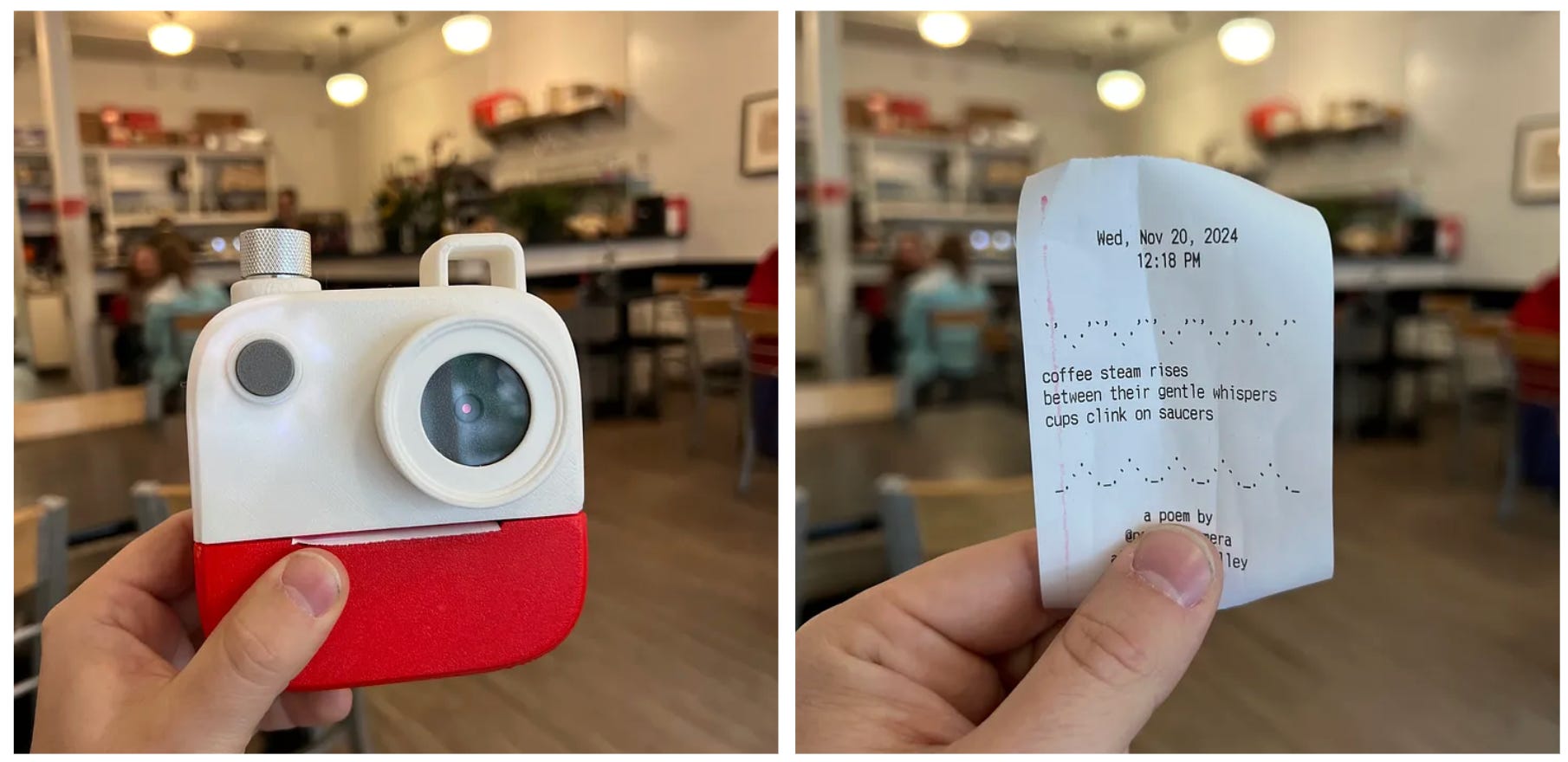
Jasmine Sun: [00:46:39] I did a podcast conversation with my friend who makes Poetry Camera.
Celine Nguyen: [00:46:44] Oh my God. I love that.
Jasmine Sun: [00:46:45] It’s a little Polaroid camera where you snap a photo and it prints out a poem that an LLM generates about what it sees. She was saying she loves the medium of an LLM in that context because it is the non-determinism that makes it exciting. It is part of the thing that you are gonna get a different poem every time. And there’s something fun about that.
But also she was like, it is fundamentally a social experience. It’s about reading the poem aloud to the other person and being able to compare the LLM’s poem output and what you are seeing in reality. So even though there could be a very narrow view that’s like, “that’s slop because LLM poems are slop,” it is clear that there’s something much deeper about embracing the fact that it’s gonna come out different every time, embracing the fact that the poem is not actually what you see in front of you. That is actually what makes it, I think, a very cool artistic invention.
Celine Nguyen: [00:47:40] I think the point about the stochasticity of AI and the social aspect of it is so interesting. With AI, one of the things people talk about as a flaw is that everyone’s LLM could be giving them totally different results when they ask a question like “Who won the presidential election?” That obviously has major stakes, but if you can treat that as a kind of interesting aspect of the medium... Do you remember that trend a while back when people were asking LLMs to draw a picture of who you think I am?
Jasmine Sun: [00:48:05] Oh yeah.
Celine Nguyen: [00:48:06] That is taking the variability and the personalized aspect of LLMs and turning it into this social experience because people would post them and send them to their friends. I saw this really funny Substack note from , who works at Substack, who had a screenshot from a Granola transcript. She was asking like, “who had the funniest jokes in the meeting?”
Jasmine Sun: [00:48:30] Oh my God. That’s so good.
Celine Nguyen: [00:48:33] I’m like, that is using AI to produce this whimsical social outcome.
Jasmine Sun: [00:48:39] That’s amazing. It’s like you upload your entire group chat transcript to ChatGPT, and you’re like, can you identify who’s the jester in the group chat? Who’s always complaining? Who roasts the hardest?
Celine Nguyen: [00:48:52] That would be so funny. Like doing these brackets where the AI is the one judging.
Jasmine Sun: [00:48:57] One broader question that I want to ask about that I was thinking about when I was reading your piece, which I loved and is titled, “Is the Internet Making Culture Worse?” You talk about the alt-weekly, the Village Voice, as the “Bell Labs of criticism,” which is an analogy that I love. It made me wonder how we measure progress in culture, which feels less obvious than how you look at progress in economics or in technology?
Celine Nguyen: [00:49:28] One quick thought on this—I felt so pleased when I thought of that “the Village Voice is the Bell Labs of criticism” thing. What I was trying to do in the piece is, there’s this one world that I have spent much of my life in which is the Silicon Valley tech world. And then there’s this world that I brute-forced my way into, which is the arts, humanities, and cultural criticism world. I’m trying to make the case that these are not two different worlds. These are not two different cultures that always have to be at loggerheads with each other. So I think that description is me trying to explicitly say we have a way of understanding excellence in the STEM world, which is research labs like Bell Labs, and then you go into this other world and people think of the Village Voice as this foundational organization that had such a major influence on American cultural life. So just trying to use the terms of these different communities to justify the value on either side. I forgot your question.
Jasmine Sun: [00:50:30] I think that was really useful. My question was how we measure progress or innovation in cultural domains.
Celine Nguyen: [00:50:36] I have seen all those articles that are like, “Culture is stagnating. It’s in decline. Literature is worse than it was in the past. Art is worse than it was in the past.” And there’s this real epistemological problem trying to figure out if that’s true because it’s like I wasn’t alive in the past when things were supposed to be good. So I’m trying to compare me as a baby in the nineties to me now as an adult in the 21st century. So whenever people make this claim of, “things are worse now than they were before, culturally,” you’re kind of like, well, how do you make that claim?
I think the theory I came up with first started from this perspective that I don’t think people today are less creative or intelligent or ambitious or experimental than they were in the past. I think that idea of, oh, people have just degraded, people are just worse now than they used to be... If anything, in the world we live in now, there are so many more people who have access to the world’s greatest art and literature, have access to so many resources to learn about these things. It doesn’t make sense to say that people are making worse cultural and artistic works. So progress has to be about something else. It’s not about the quality of the works in the world.
Progress is really a feeling and a narrative. When we say that culture is progressing, it’s because we have the right narrative that is like, this is improving, this is improving, this is improving. When we feel like we can’t construct a coherent narrative of, this artistic movement was succeeded with this one, and this medium was developing in all these new and exciting ways, that’s what decline and stagnation is. It’s not that everyone is suddenly mysteriously dumber and less creative. It’s that we don’t have that story. And then I was like, okay, well why don’t we have that story? Who is telling that story?
That’s where I come to my conclusion in the piece, which is that there are a lot of people creating art, but there’s a difference between having people creating art and having that labeled as, “this is an artistic movement.” Very often you do have artistic movements where those people are writing a manifesto and saying, “this is who we are, this is what we’re about.” But another big aspect of is all the people that are contemporaneously writing about the movement, saying people should pay attention to this. They’re creating this secondary material that then becomes part of a historical narrative. If you put together an art exhibition and maybe a bunch of people are involved in it, it kind of feels like a bit of a movement. But if then no one writes about it, no one takes any documentation. In 10 years, no one will know that existed.
Jasmine Sun: [00:53:30] In a way, cultural production today is more documented than ever, right? You probably won’t have the lack of oral histories and whatever because everything is being recorded and posted somewhere. There’s almost always somebody who has taken a photo, who has posted the thing. And then for culture that is happening online, do you think that we are seeing fewer people doing that and making sense from the mass of data points that are on the internet? Or do you think it’s only gonna be in a decade or two looking back that people will be able to characterize scenes?
Celine Nguyen: [00:54:10] I think in terms of information landscape, we’ve probably moved from this period of scarcity to a period of excess.
So when you look at histories of the past, the main problem is that there’s just not enough information. If you are a medieval historian or an early modern historian, it’s like, how do you know what women were doing in that period if they weren’t able to write? Or people who were working class never had their experiences recorded. When you look into the past, you’re dealing with, in many cases, a deficit of data. And now, because so many ordinary people have access to publish things and write things and put their work out there, we don’t have this old historian problem of, you don’t have enough information to write a history from below or to write about all these different movements. Now we have this problem of an excess of information and it’s just a different problem.
Maybe in the past you had very few people who were able to publish a work of criticism that said that this is a new movement and have it be distributed. But then if you were able to do that, you had a pretty good shot at embedding that into the history books, let’s say. And now it’s like everyone can publish, but all those different claims are getting lost in this massive sea and it’s hard for any one narrative to rise up to the top. There’s this aspect too of narratives needing to attach to each other. When you think about the idea of girlhood or hetero-pessimism, it was like you had a few breakout articles. I feel like we don’t really have the focusing capacity to turn small bubbles into these bigger narrative trends.
Jasmine Sun: [00:55:49] I’ve been thinking about how to do good culture writing. There’s culture writing and then there are trend pieces. One version of culture writing that I get tired by is the, “I saw three tweets about this and now I’m gonna say this is actually a movement.”
Celine Nguyen: [00:56:04] Oh my god. Yeah.
Jasmine Sun: [00:56:04] And there’s a way in which, because everyone can produce things now, people are labeling new trends and new movements and new subcultures all the time, right? But because it is happening in excess, as you say, none of it feels that important or that resonant. And how do I do culture writing that is deeper than the “I saw three tweets” trend piece? How do you do culture writing that rises above the fray?
Celine Nguyen: [00:56:43] A few thoughts while I try to get my way to some sort of definitive statement. One is that I am really annoyed by that kind of writing too, and I almost think of that as, that is human-produced slop. Well before AI slop, we had all this bad journalism, all these bad listicles.
But I found this really amazing newsletter where this guy wrote something that was like, “So when is AI supposed to take my job?” He was talking about how AI cannot replace a certain form of journalism, which is going and interviewing people, developing a rapport with them, bringing new data that doesn’t exist in a data set into a piece of writing. And he’s like, AI can’t do that, but it can do a lot of the shitty listicle writing. “AI shouldn’t write that story; no one should write that story.”
Jasmine Sun: [00:57:34] You could literally take any three random tweets, put them into ChatGPT, and be like, generate me a 500-word trend piece about this, and it would find a way. I guarantee it.
Celine Nguyen: [00:57:46] I feel like there’s some good single-purpose website that’s like, “Is this AI slop or is this human-produced slop?”
One also personal reaction I have is, I haven’t opened TikTok in two or three years. But because I’m not on TikTok, I notice how many trend articles are just some algorithmic blip that everyone is seeing that week. And everyone feels this extremely strong, powerful need to write about “thot daughters” and how performative they are. And I’m like, is this a real thing? Why is everyone talking about this? And then two weeks later, it’s not a real thing. And I’m like, you guys, why did you show me that content? Are we really going to pick up every random tradwife trend on TikTok and be like, what does this say about feminism in the 21st century? Maybe it says absolutely nothing. Maybe it’s two or three people made some vapid content.
Jasmine Sun: [00:58:43] Maybe the ML engineer shipped a minor algorithm update and it accidentally started amplifying the tradwife content slightly more. And now we’ve decided that…
Celine Nguyen: [00:58:53] ...it’d say something about society.
Jasmine Sun: [00:58:54] Yeah. And I’m like, actually it doesn’t. But it’s hard because I don’t want to be one of those people who’s like, the internet is not real life, because as we know, the internet is a shaper of culture. But what is that line?
Celine Nguyen: [00:59:10] I.wonder if part of the reason I ran off in the direction of writing book reviews is that it is really hard if your beat is internet cultural criticism to do things that are consistently influential and speak to something greater. Part of the success of Jia Tolentino’s first essay collection and her essays on Instagram face and stuff like that came about because she was able to take a few Instagram posts and really actually pull out this bigger, broader argument. It’s hard. You don’t have a sense of scale. Maybe some of it is the pressure to publish regularly.
Jasmine Sun: [00:59:47] You also have to go outside. Jia goes outside and so she can look at the trend online and know whether or not Instagram face is a thing that actual people are doing that is coming up in real life conversations. I was on the East Coast last week, and people asked me whether particular Twitter trends they see coming out of SF Tech Twitter are real. Do people actually 996, or are they just saying that? Do people actually think Cluely is a good company?
If you are not in the culture beyond the internet, you will not have good enough antibodies to know whether it’s a one-off viral thing that says nothing deeper, whether or not it’s bait. So many tweets are bait. There are people tweeting about American politics who do not live in America and they are distorting our view of what our fellow citizens believe. Good culture writing has to come from being both an observer and a participant, someone who can vibe-check: how much does this random viral video actually say about how we live together?
Celine Nguyen: [01:00:51] I think that’s actually a great point. If it’s just something that’s on TikTok for a few weeks, that’s not a real trend. But if it’s something where this TikTok thing testifies to this real-life practice that is shaping how people live, then maybe that’s something that’s more significant because it is something about culture more broadly and not just what one particular app’s algorithm is showing to a few subsets of people.
Jasmine Sun: [01:01:08] When I was writing my piece about bait and vice signaling, I was trying to decide whether I was taking the bait by even writing about these companies, because I don’t think that most companies in Silicon Valley are doing this. Then I was like, I think the way for me to write is to not take it at face value of “they are saying they’re gonna take all the jobs, therefore they’re going to take all the jobs.” Rather: what is the political economy of the startup scene that incentivizes startups to run these crazy billboards? That was my justification that this is a deeper piece than just a trend piece and taking the bait by posting about it.
Celine Nguyen: [01:01:46] I have to say framing it as bait is actually really, really revelatory for me. Literally just before signing on to talk to you about this, I was reading this Reddit post where someone was like, in the Netherlands there are all these AI-generated songs that are trending on the Spotify charts and they have AI-generated, very anti-refugee lyrics. And I was like, wow, this is so interesting and insidious. And then I looked at the comments and a lot of people are like, wait, are real people streaming this? Is the concern that real people in the Netherlands are constantly streaming anti-migrant generated music? Or is it that they’re bot-streaming bot-created music to create this trend that will then create this whole series of takes? Are people in the Netherlands actually becoming more anti-migrant?
Your framing of bait made me wonder if people are intentionally exploiting this culture journalism hot-take-y way of surveilling internet trends and being like, this must speak to something deeper. And to what degree can that be engineered so you can create a totally manufactured trend?
Jasmine Sun: Right. It’s a whole dead internet theory thing where it is possible that both sides of it are bots. I think of when celebrities have PR relationships or influencers stage dramas with each other, where both people are in on it. We can consume that as a form of entertainment. But if we start to think this is actually how people treat each other, that these are real behaviors that we can draw broad conclusions from, that’s the point at which we are taking the bait. And human writers might buy into amplifying these more unsavory trends just out of a lack of discernment.
Celine Nguyen: [01:03:32] This makes me think of show boxing and how we are now in this media environment where you can have totally constructed fake matches between one bot army and another bot army. They can be weaponized to create these political or cultural debates, which may not even be real, but where we are the audience. We’re all conscripted into this fantasy.
Jasmine Sun: [01:03:55] A lot of Republican culture war stuff is that. For a long time, Republicans couldn’t win on economic issues because their economic policies were unpopular, and you couldn’t get a majority of the voter base to vote with you. So Republicans had to shift the terrain onto what are partly real and partly manufactured culture war issues so that they could actually get more than 50% of the vote.
Celine Nguyen: [01:04:13] Years ago, an ex of mine said something which I found very insightful. He said that on the internet, there’s no such thing as a strawman argument. You have this idea of someone setting up a strawman and you’re like, that’s not something a real person would say. But there’s always someone online who’s unhinged enough to say that. If you are a very transphobic organization, you can definitely find one real trans person who states a viewpoint in a way which is so outré, so beyond what most people believe, and you’re can act as if that’s everyone in the community.
Jasmine Sun: [01:04:47] I wanna be conscious of time and we are nearing the end. So I want to ask you some more tactical questions about your writing life. To start, how do you use social media today?
Celine Nguyen: [01:04:58] So I, controversially, am pro-social media. For most of my twenties I was like, I can’t be on Instagram. It’s going to make me paranoid. It’s going to give me body dysmorphia. And then I realized social media is how people meet other people who have their very niche interests, who may not be geographically near them, or who may not already be part of their social circles. So, about two years ago, I was like, I should be using Instagram more. I should be using Twitter more. To be honest, the only social media I’m really using quite regularly is Substack, because I’m text-oriented and there’s no character limit on Substack.
I do think that it helps to be on a kind of personal version of social media where if you are writing about art, you just make all of your social media about contemporary art and art critics and new art releases, and you create this funneled world that just totally reinforces the thing you’re trying to do. That’s very much what I’ve done with social media.
Jasmine Sun: [01:06:00] It’s a vehicle for aspiration in the Agnes Callard sense. You decide this is the sort of person I want to be, that sort of person would consume this type of content. Let me go and follow a bunch of podcasts and Instagram accounts and whatever, and steep in that until I am that kind of person.
Okay, how do you use AI?
Celine Nguyen: [01:06:17] I do use AI for a lot of vibe coding, which is very fun because I’m someone who had a CS degree that I basically never use. I sort of learned how to use JavaScript and then modern contemporary web development standards have really passed me by. So now I’m like, okay, thank God I never had to learn that shit after all. I’m just going to make AI build my React apps. So that has been quite fun.
I have tried to use it for writing with mixed results. I’m a control freak, so I never use it to write the final sentences. I was initially like, oh, can I use AI for researching sources? And I found that it only works for a certain type of source because if you’re a writer, even the sources you’re referencing are a way of demonstrating your taste. It’s the particular reference points, the juxtaposition. I really enjoy the pieces where I’m like, I’m going to take this philosophy book and I’m going to take this sociology book and I’m going to take this history of technology book. It’s fun to pull things from unexpected worlds into the same world of a piece. And so when that becomes a really important part of taste, then you have to prompt AI so excessively.
I do use AI for “Take this bit of text, list every claim, fact-check it for me. If I’ve written anything wrong, provide three different versions and explain to me why they’re more factually correct.”
Jasmine Sun: [01:07:33] Oh, I do that too. The fact-checking thing is so useful. People talk so much about the hallucinations, but I make shit up all the time. On accident, to be clear. I am always hallucinating things and so sometimes I’ll be like, this sounds true to me, but I can tell that I actually haven’t done the research. So use the AI to make sure that what I’m saying is correct.
Celine Nguyen: [01:07:56] I actually think AI is amazing for writing an extremely factually dense sentence that is going to be pre-AI, two hours of research to compress that in. And with AI it’s like 10 minutes and then I check the AI’s sources and then I have my fact.
Jasmine Sun: [01:08:10] We’ve talked a lot about Substack, but you also write for magazines and more traditional literary publications. What role do Substack versus magazines play in your writing career?
Celine Nguyen: [01:08:21] I know some people who are obviously all in on the magazine side and they don’t do serious pieces on their Substack. Their Substack is personal or for discourse. There are people who obviously are all in on Substack and are like, gatekeepers are annoying, editors are annoying, you don’t get a large audience that way. I kind of want to do serious essays in both domains.
With magazines, the lead time is a lot longer, which I think is good in many ways because I think sometimes you just need time to mature. An idea that I’ve been working on for three months is deeper than one that I’ve done in three weeks. The Substack ones are always three-week-long ideas, because at some point I’ll be like, you know what? I should just publish this. I should just send it out and move on.
When I’m writing for a publication, I have this feeling that I want to impress the editor. Knowing that I am reaching that specific audience first, who will be reading it very deeply and comprehensively and critically, just pushes my work to another level. I would say too that all of the editors I’ve worked with have really taught me something about writing. The first book review I published was with the Cleveland Review of Books, which I love as a publication. And my editor there would just make these little directional edits that were so incredibly helpful and shaped every other book review I’ve done. One of the reasons I’m most sad about the economic model for cultural criticism and newspapers collapsing is just that being edited is how you learn as a writer. For a nonfiction writer, if you get edited by a bunch of really good people, that’s kind of equivalent to a creative writing MFA. But if there aren’t enough people who can be full-time editors making money, then how are you going to get that training?
Jasmine Sun: [01:09:59] I once asked Sheon, “Do you have any nonfiction writing workshop recommendations that I should sign up for?” And he was like, “You should just pitch because then an editor will pay you to learn.” I was like, whoa.
Celine Nguyen: [01:10:13] The problem of course is the pitching. That’s the main reason why I think I enjoy writing on Substack. I think it’s good to have some level of gatekeeping because it forces your ideas to rise to another level. But you pitch things, you may not get a response, that’s very demoralizing. My friend Wendy Liu who wrote Abolish Silicon Valley, we have been talking about starting a rejection spreadsheet and setting rejection goals. We’ll text each other and be like, we should pitch this place and get rejected. We should pitch this place and get rejected. It’s a nice way of reframing what is the most demoralizing part of pitching, which is people might never write you back.
Jasmine Sun: [01:10:52] I know. I hate pitching. I legitimately think that my hatred of pitching is the main reason that I don’t freelance more, more than all of my philosophical things about legacy media and whatever. It’s so many hours writing up an idea to get zero response back.
I want to ask about the design of your Substack posts. You use numbered lists, you use images or quotes or tags. How do you think about that?
Celine Nguyen: [01:11:15] I’m a Markdown freak. I love Markdown, so all of my personal notes are just intensively formatted. I do the block quotes, I do the lists and things like that.
I also write really long newsletters and I really think a lot of people read to the end. I have this Proust newsletter that went viral earlier this year. It’s something like 5,000 words. Actually, a lot of people read to the end. I have comments and emails that reference things deep into the post. I feel very strongly that people can read something long-form on their phones, but it’s very easy to get bored. And so a lot of the formatting I do is to feel as visually varied as possible. Lists are a nice visual break; block quotes are a nice visual break; having generous images throughout; having a few short paragraphs and a few long ones. Sometimes I see newsletters where I’m like, the content in this is so good, but there are no images. There are no subheadings. There are no little lists.
Jasmine Sun: [01:12:12] Or the paragraphs take up the entire screen on your phone.
Celine Nguyen: [01:12:16] I think visual variation is how you get people to read long-form on a screen.
Jasmine Sun: [01:12:21] That makes sense. The longest thing I wrote was this post about China, and it was 7,000 words.
Celine Nguyen: [01:12:27] But I read that in one sitting.
Jasmine Sun: [01:12:29] Thank you. I’m very happy to hear that. Somebody else also messaged me and she was like, “I love that post. It’s so brisk.” And I was like, brisk is not the word I would’ve used. Because it is 7,000 words. But my logic was if I just put some travel photos in between every few paragraphs, then maybe no one will notice.
Celine Nguyen: [01:12:51] To what I was saying at the very beginning about the importance of headings and having a clickbait headline to package your thing. I’m also like, images breaking up visually a long bit of text, that is how you get people to absorb an extremely long-form complicated argument.
Jasmine Sun: [01:13:01] Okay, last real question, which is that you love self-help. Lots of people look down on self-help. Tell me why you love self-help.
Celine Nguyen: [01:13:10] It is kind of cringe, but I just really believe in the capacity to transform yourself.
Self-help is founded on this idea that if you don’t like who you are, if you don’t like something about yourself, you can change it. And you don’t have to throw up your hands and be like, I just have these flaws, I have these sensitivities, I have these anxieties, and I’ll never get over them. I think maybe it’s because I went through this period as a child where I was incredibly, incredibly shy, never spoke to people, and my hands would get very sweaty. I’d feel very panicked. My heart would start beating faster if I was called on in class to answer something. And so I think the transition from being that person who was just so compulsively shy to someone who can talk to random strangers if I go to a reading and I want to make new friends. The fact that I went from someone who was compulsively afraid of sharing my writing online, was always afraid it would never be good enough, and was always so fearful and ashamed and in a shell to someone who now shares a lot of my writing all the time compulsively.
Yeah, I think I believe in self-transformation. I think self-help is the thing you read if you just want to convince yourself that it’s possible.
Jasmine Sun: [01:14:29] “I believe in self-transformation” is a really good way to end. Thank you so much, Celine. Where can people follow your work?
Celine Nguyen: [01:14:35] It’s all on my Substack, personalcanon.com. And then sometimes I’ll write in other places and then I will send out a little newsletter, sometimes delayed by a week or two because they’re always pointlessly long, about what I’m up to.

Jasmine Sun: [01:14:52] Yes, please sign up for Celine’s newsletter. If you enjoyed this episode, please send it to a friend and you can find full transcripts and links and other unrelated essays at jasmine.substack.com.
Celine Nguyen: [01:15:08] Thank you. This was great.
Thanks for reading and listening,
Jasmine